ASPIRE
ASPIRE (the AStrochemical & Planetary materials IRradiation Experiment) is a new research setup located at TRIUMF (Canada's Particle Accelerator Centre) in Vancouver, Canada. ASPIRE irradiates materials with beams of stable or rare/exotic radioactive isotopes to enable leading-edge interdisciplinary research across fields (i.e., in non-traditional subjects for TRIUMF that greatly benefit from particle accelerator techniques).
The ASPIRE irradiation chambers are highly customizable to specific experiment requirements. Samples removed post-irradiation (depending on the nature of the beam) can be analyzed externally by a multitude of techniques.
Scientific research collaborations are highly encouraged.
(Contact: ccharles@triumf.ca).
Solids
Irradiation of diverse solids, e.g., pressed powders, porous or crystalline phases, biological media, ices (cryogenic), or anthropogenic materials (electronics, plastics, etc).
Liquids
Ongoing R&D to irradiate liquids (i.e. waters, etc) with accelerated helium or other ions to study radiolysis. Irradiation of molten (high temp.) phases are possible.
Gases
Irradiation of gases or gas mixtures in thin-window cells.
Capabilities
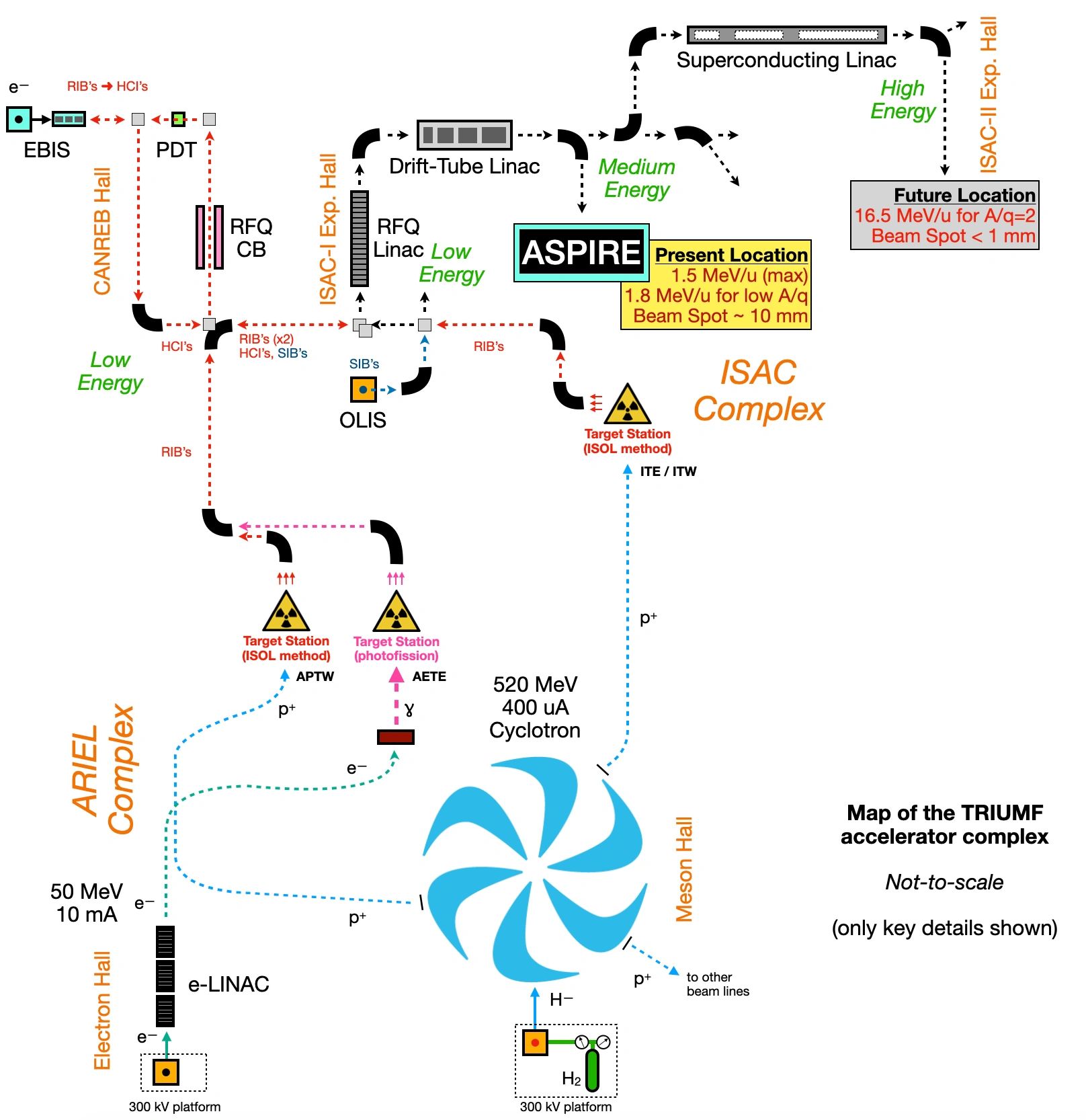
ASPIRE is based in the medium-energy area of ISAC (the Isotope Separator and ACcelerator complex) at TRIUMF.
The setup can irradiate materials with d = 10 mm isotope beams spanning the chart of the nuclides consisting of:
- Stable isotopes of (A) nearly all elements below U, produced at the Off-Line Ion Sources (OLIS) facility <160 nA up to 1.5 MeV/u, or (B) light elements i.e., H, He, O, N, CO2, etc at <4 keV by a PIG source locally at ASPIRE.
- Radioactive isotopes of nearly any element including U up to 1.5 MeV/u by targets at ISAC or ARIEL (the Advanced Rare IsotopE Laboratory). Both ISAC and ARIEL targets are driven by 520 MeV p+ beams from the main cyclotron; ARIEL also has one photofission target driven by 50 MeV e- produced by a linear accelerator (the e-LINAC).
In the future, ASPIRE can move to the ISAC high-energy area at 16.5 MeV/u, well above the Coulomb barrier for nuclear reactions.